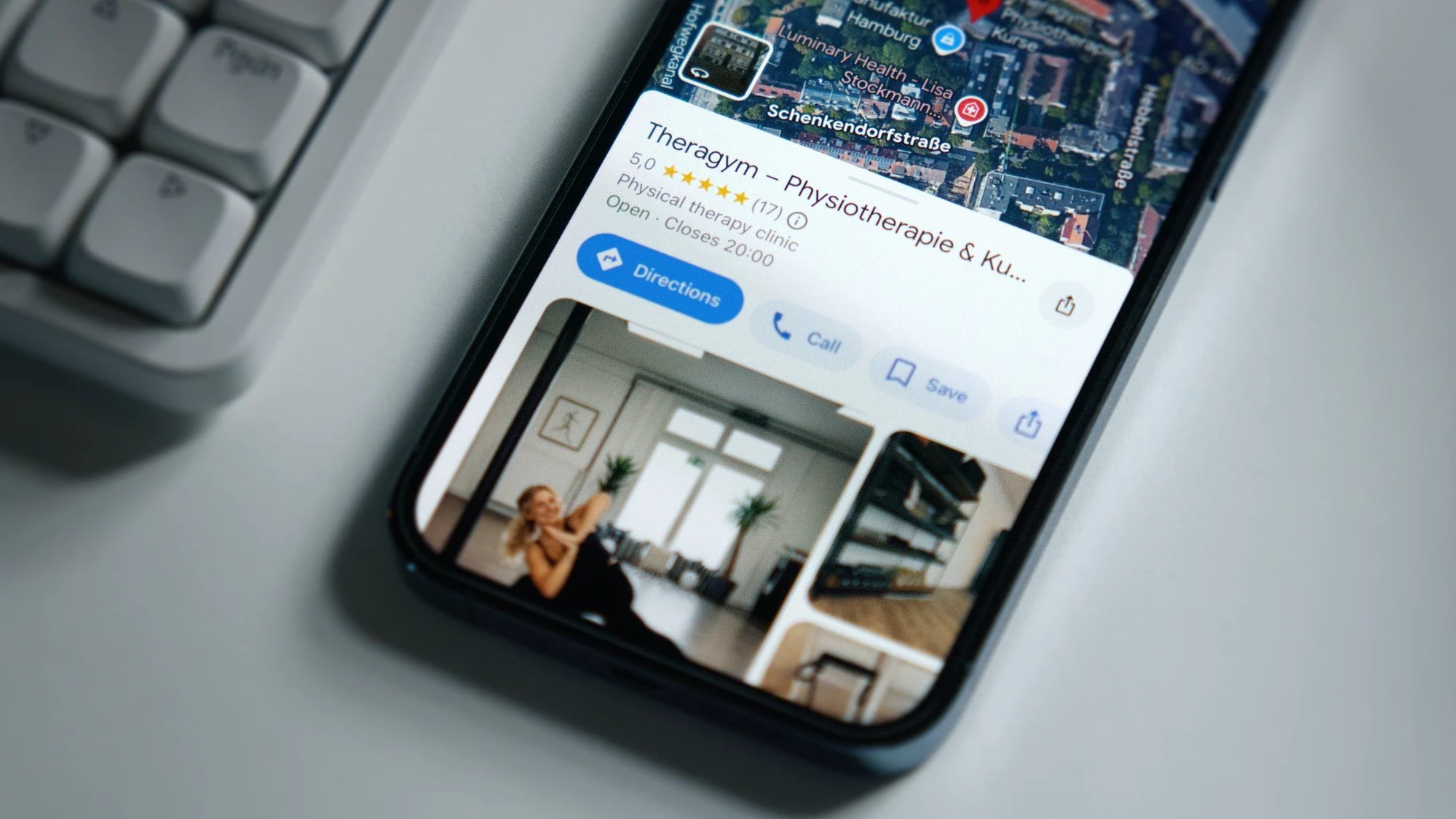
Search for "physio near me" or "tax advisor Salzburg" and Google first shows you a map with three listings, the so-called local pack. The normal results only come below it. If you're in that map, you get the calls, the directions requests and the enquiries.
Local SEO is everything that gets you there: into that map, into Google Maps and into the search results tied to a place. Whether you call it local SEO or local search optimisation doesn't matter, it's the same thing.
Here's how Google decides locally, and what you can do about it in five steps. Based on what we see with our clients.
How Google decides who to show locally
Google is pretty open about it in its own Business Profile help: local results mainly come down to three things.
- Relevance: Does your listing match what people are searching for?
- Distance: How close are you to the person searching, or to the place they name?
- Prominence: How well known is your business? That includes reviews, mentions around the web and links to your website.
You can't change distance. Relevance and prominence you can, and that's exactly what the five steps are about.
1. A complete Google Business Profile
Your Google Business Profile is the listing that shows up in the map. The more complete it is, the better Google understands what you should be found for.
- The right primary category, plus fitting additional categories. It makes up a big part of relevance.
- Every service on its own, with a sentence about it, not as one block.
- Opening hours, phone number, website, and your area: an address if customers come to you, otherwise the area you work in.
- Real photos of your premises, your team, your work.
- A post every so often, say a project or an offer. A profile that's alive comes across differently from one that's been silent for years.
How we set this up and look after it for our clients is on our Google Maps page.
2. Reviews, regularly
Reviews are the strongest part of prominence. It's not just how many you have, it's also that new ones keep coming in.
- Ask after every job, ideally with a direct link or a QR code. Lots of people are happy to leave a review when you ask.
- Ask them to mention the service and the place. "Finished our bathroom in Salzburg-Lehen in one week" helps Google more than "Great service".
- Reply to every review, the bad ones too, calmly and to the point.
- Never buy reviews and don't offer anything in return for them. Google bans both and deletes those reviews.
3. The same contact details everywhere
Google cross-checks what's out there about you. If your name, address and phone number match everywhere, that's a clear sign you really exist.
Go through everything once: your website, your Google profile, Herold and Gelbe Seiten, Apple Maps, Bing Places, industry directories and your social media profiles. One old address or a second phone number somewhere is enough to make Google unsure.
4. A website that confirms the location
What's in your Google profile has to be on your website too. Then Google trusts both.
- One page per service, with the place in the heading and in the text. That way there's a page that fits every search exactly.
- Address and area easy to see, with a map on the contact page too.
- Structured data (local business schema), so Google can read your address, opening hours and services reliably.
- Fast and good on mobile, because people searching nearby are usually on the move.
For Theragym in Hamburg we built around 15 of these pages, each for one service in the neighbourhood, like "yoga Uhlenhorst" or "pilates Uhlenhorst". Today they get over 10 enquiries a month.
Careful with city pages off the production line: Google treats ten near-identical pages where only the place name is swapped as doorway pages and ranks them down. A page for a place is worth it if you really work there and have something of your own to say about it.
5. Mentions from your area
Prominence also comes from places where other people write about you: a link from a club you support, from partners you work with, a story in the local paper, a listing with your trade association. A few real mentions from your region count for more than lots of random ones.
Local SEO for service businesses that go to their customers
Electricians, plumbers, painters, cleaning companies, mobile physios: lots of service businesses don't have a shop customers walk into. Local SEO still works, just a bit differently.
- Area instead of address: In your Google profile you add a service area, meaning the towns and districts you work in, and hide your address. Google recommends keeping the area to about two hours' drive around your base.
- One profile per real location: a virtual office, a PO box or a coworking desk just to have an address in town breaks Google's guidelines. Google checks this and suspends those profiles.
- Further out through your website: In the map you're strongest around your base. For the places you often work in, a page of its own on your website helps, with real projects from there: photos, a review from a customer in that town, what you did there.
Your customers' search terms
Before you optimise anything, take a look at how your customers search. For local service businesses it's almost always the same patterns:
- Service and place: "electrician Salzburg", "physio Linz".
- Service near me: "plumber near me". Here distance decides most, which is why your profile matters.
- The problem and the place: "burst pipe Salzburg", "back pain physio Graz". People searching like that usually need you right now.
- Urgency: "emergency", "today", "at the weekend". If that fits you, it belongs in your profile and on your website.
You'll find these terms in the suggestions Google makes as you type, in "People also ask" under the results and in Google's Keyword Planner. Easiest of all, though: ask new customers what they searched for. Every important term then gets a service in your profile and a page on your website.
The most common mistakes
- Search terms in the business name: "Huber Painters Salzburg Cheap" instead of "Huber Painters". That breaks Google's guidelines and can cost you the profile.
- A category that's too general, like "Service provider" instead of "Electrician".
- Different phone numbers on your website, profile and directories.
- A homepage that doesn't mention the place anywhere.
- Reviews nobody replies to, especially the critical ones.
- A profile nobody has touched in years: old opening hours, no photos, no posts.
Measuring what local SEO brings in
- The stats in your Google profile show calls, directions requests, clicks to your website and the search terms people found you with.
- An extra bit on the website link in your profile: Add "?utm_source=google&utm_medium=maps". Then your website stats show who comes in through Google Maps, no cookies needed.
- Ask: "How did you find us?" with every new enquiry. It's the simplest way to measure, and often the most accurate.
How fast local SEO works
Local search terms are easier to win than national ones, because you're only up against the businesses in your area. Filling in a patchy profile often shows results within a few weeks. For competitive terms it realistically takes 3 to 6 months to get to the top, because reviews and mentions grow over time.
Our client Shooting Guns Vienna is number 1 today for "shooting range Vienna" and gets over 30 bookings a month, without any paid ads.
Local SEO and ChatGPT
When someone asks ChatGPT for a business nearby, ChatGPT looks heavily at the same data: your Google Maps listing, your reviews, the services on your website. So if your local setup is clean, ChatGPT is more likely to name you too. How that works exactly is in our guide to ChatGPT SEO.
Your checklist
- Complete Google profile: primary category, every service, opening hours, area, real photos.
- A post every week in your profile.
- Ask for a review after every job, with the service and the place in the text, and reply to every one.
- Match your contact details: the same name, the same address, the same phone number everywhere.
- One page per service on your website, with the place in it.
- Collect real mentions from your region.
Where do you stand right now? Request a profile analysis: we compare your Google profile with the top three in your area, for free. Rather have a quick chat first? Book a call.