From day one you see which route new patients come through. GDPR-compliant.
Success story: Theragym
15+ new enquiries a month. From Google and ChatGPT, without anyone giving it a push.
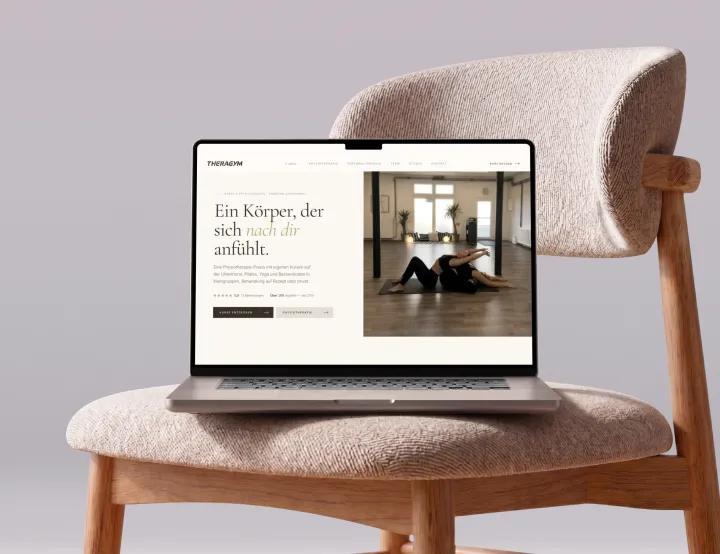
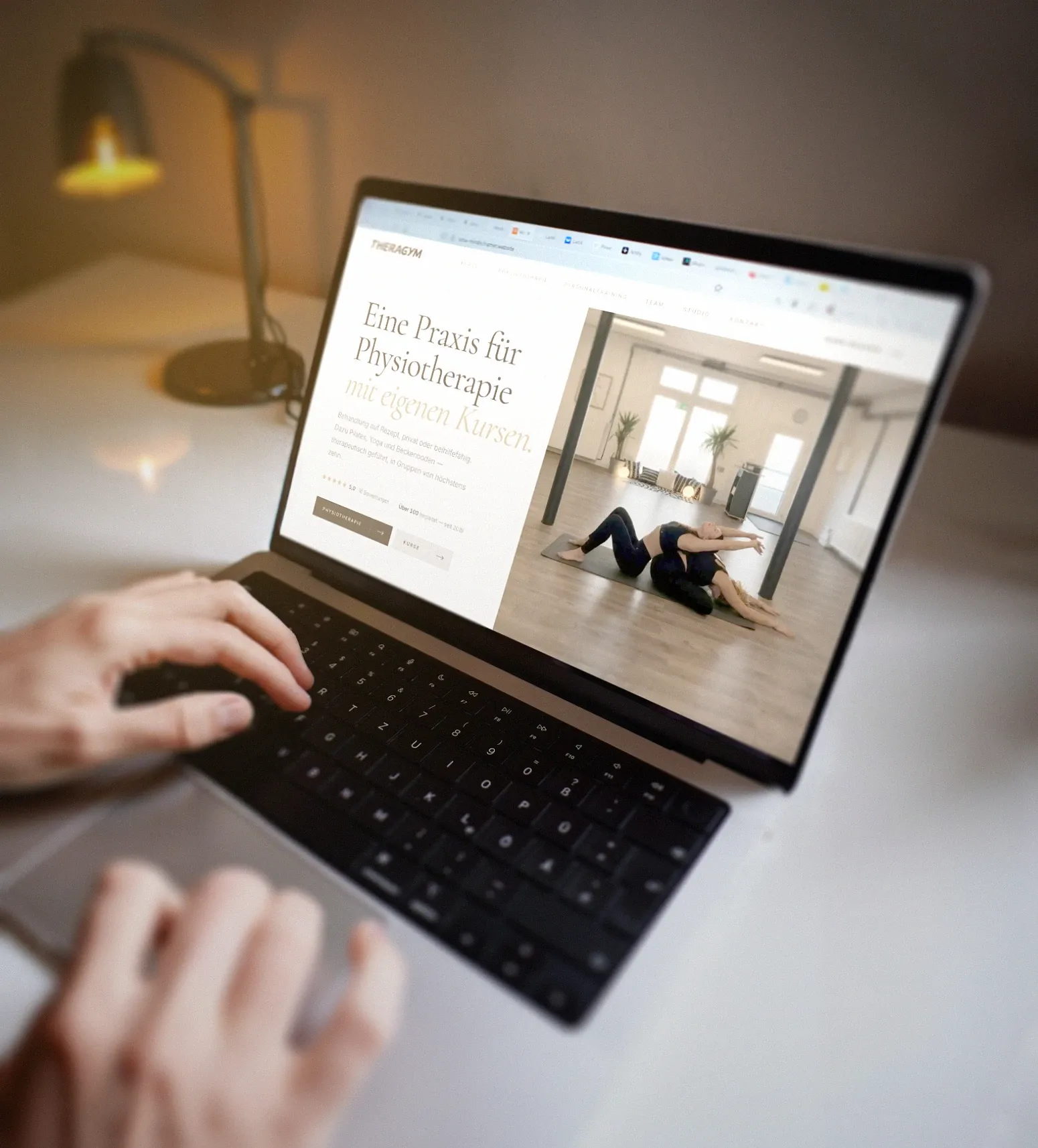
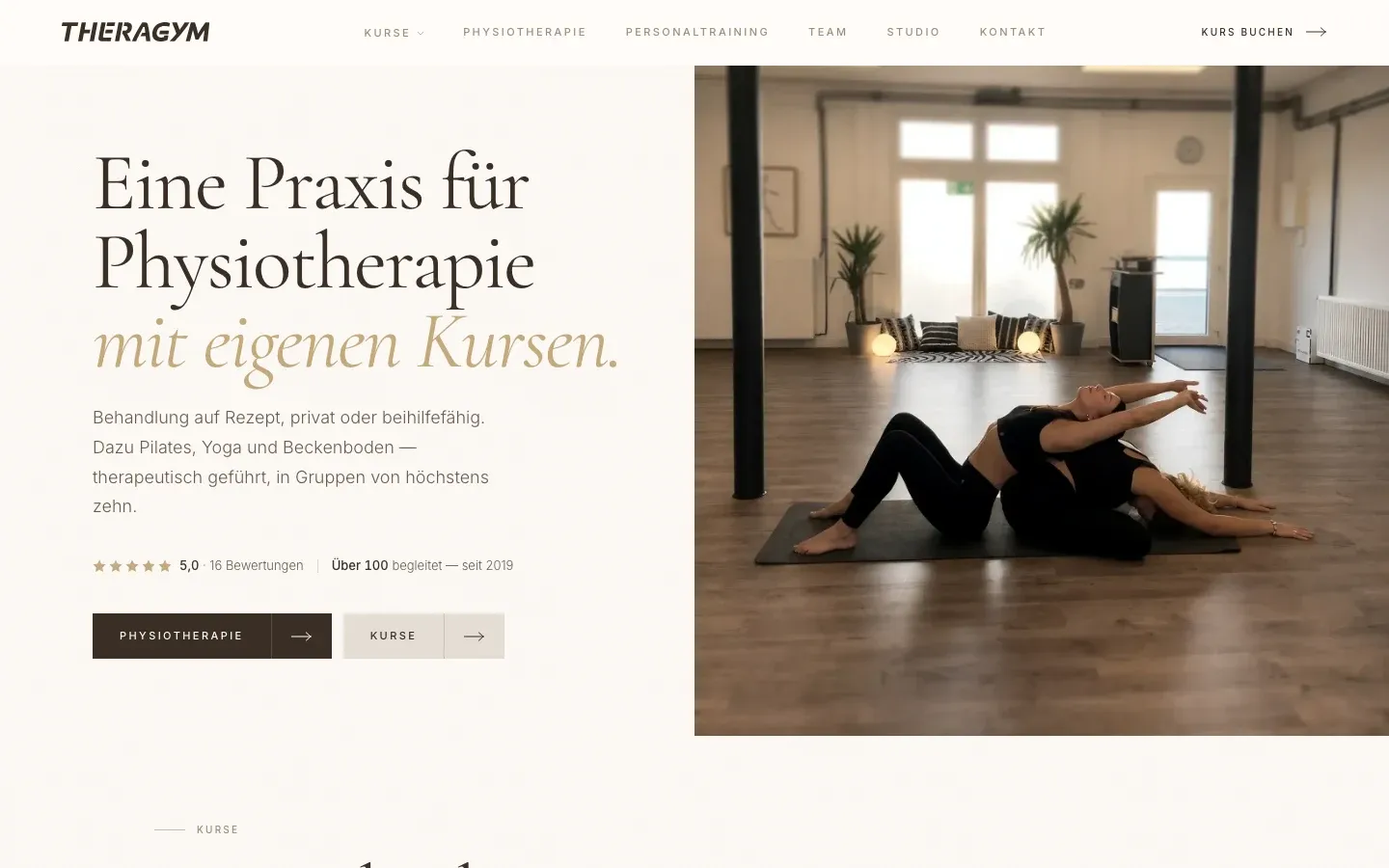
Theragym, a physiotherapy centre with its own classes in Hamburg.
15+new enquiries a month
1 in 4visitors comes via ChatGPT
5.0stars on Google
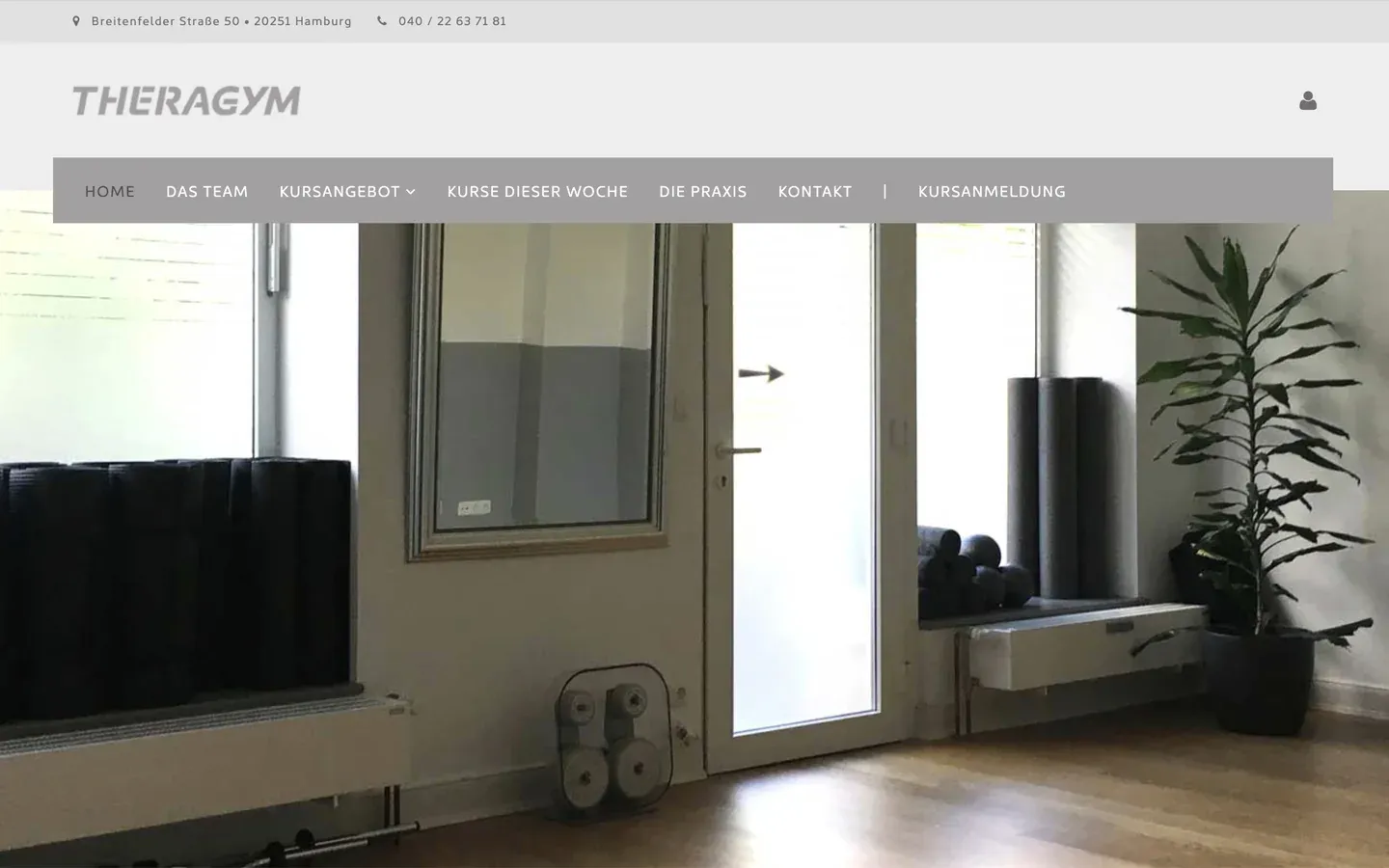
VorherNachher
“After bad experiences with other agencies, Studio Erlach was a real stroke of luck. The process and the costs were agreed upfront and stuck to, and within a very short time we were getting far more enquiries.”
This is how we build it in. In 90 days, alongside your day-to-day at the practice.
You put in one conversation and a little feedback. We build the rest while you treat patients.
Weeks 1 to 2
The conversation and the plan
Which patients you want more of, which treatments and classes are worth it, what a new patient brings you. From that we build the plan for your practice.
01
Weeks 3 to 6
Website and booking
Copy, design and online booking, plus a page for every treatment people in your area search for.
02
Weeks 6 to 8
Google, Maps and ChatGPT
Your profile on the map, the first new reviews and the listings AI assistants learn from.
03
Until day 90
It runs
New patients find you and book. We count every enquiry and keep refining until there are at least 15 every month.
“Studio Erlach laid the foundation for my success. Startup or established company, I can recommend the team to anyone looking for a capable partner who gets things done.”
Lorenz G.Founder, SGV
“Studio Erlach just gets things done. Uncomplicated, professional, creative. Our online shop is on a new level, and our sales have risen markedly since the relaunch.”
Janina K.Founder, Bon Voyage Interieur
“We wanted to hand the work over completely, to a partner who thinks for themselves and delivers without us having to look after them all the time. The result is excellent.”
Kevin K.Co-Founder, ALPAI26
“I can recommend working with Tobias and his team with all my heart. Everything was excellent, and Studio Erlach has been my first port of call ever since.”
Christian M.Founder, Investor College
The price
One price, two payments. The second only once the enquiries are in.
Apply now A two-minute application. No commitment yet, on either side.
Guide
Winning new patients in physiotherapy: everything in detail.
In short: new patients choose their physiotherapist themselves today, via Google Maps, Google Search and ChatGPT. Whoever comes first there, with genuine reviews, a page for every treatment and online booking, gets the appointments. Here’s how it works, for private, insurance and mixed practices in Austria, Germany and Switzerland.
As a private physiotherapist without a health insurance contract (in Austria a Wahltherapeut), you win every patient yourself. They pay you first and then claim the bill back from their insurer. With a doctor’s prescription, Austria’s public insurer ÖGK refunds 80 per cent of what it pays a contracted therapist for the same treatment; no prior approval is needed at the moment. That’s why they need to understand before the first appointment why they should come to you: what you treat, how you work, what it costs and what they get back. That is exactly what belongs on your website, and Austria’s MTD Act requires you to explain costs and refunds anyway.
With an insurance contract the diary is often full, but the rates are fixed. You grow there with what you offer privately: self-pay treatments, private patients, classes, training after therapy. That’s exactly what people near you search for, and exactly where a page of its own with online booking pays off.
If you do both, we decide in the first conversation what new patients should come for. Usually it’s the self-pay treatments and classes. In Germany, health insurers subsidise certified prevention classes. If yours are, it belongs on the class page, because it’s often the reason someone books.
What patients search for
Patients rarely search for a practice by name. They search for what’s wrong and for what they’ve been recommended. Almost every search is one of four kinds. By complaint: “physio for back pain”, “shoulder physio”, “knee after surgery”. By treatment: “manual therapy”, “lymphatic drainage”, “TMJ treatment”, “Pilates class”. By place: “physio near me”, the neighbourhood, the town. And by what suits them right now: “physio Saturday”, “home visit”, “appointment this week”.
That tells you what your practice needs: a page for every treatment and every common complaint, a Google profile that lists each service on its own, and answers to the questions people have before the first appointment. With a prescription or private? How long is the wait? Where do I park?
Which of these searches really happen in your area, we check with real search numbers before we start. The pages follow from that, not from a textbook list.
Portals, ads or a channel of your own
Three routes bring new patients without leaving it to chance. Booking portals bring appointments for as long as you pay, and show you there among other practices. Patients remember the portal, your practice only in passing.
Google Ads bring in calls quickly, especially with ads right in Google Maps. As soon as you stop the budget, the enquiries stop too. That’s fine for a quick start or a new class; as your only route, you pay again every month. More on this at Google Ads.
A channel of your own takes longer: the profile, the pages, the reviews and the recommendation in ChatGPT grow over weeks. In return it belongs to you. It brings enquiries without you paying for every click, and every page and every review stays. That’s the channel Found First builds, and we add ads on request where they pay off.
In the top three on Google Maps
New patients search with a place or a complaint: “physio near me”, “physiotherapy Eimsbüttel”, “manual therapy Salzburg”, “physio for back pain”. Google then shows the map with three practices first, and the normal results below it. Whoever is in the top three on the map gets most of the calls.
For that, your Google Business Profile needs everything it can hold: the right category, every treatment as its own service, real photos of the practice, current opening hours and regular posts. In a small town this often goes faster than in a big one, because fewer practices compete for the same three places.
Where your practice stands today, the free profile analysis shows you.
A page for every treatment
A homepage that lists every service gets found for none of them. Patients search for what’s wrong and for the treatment someone recommended: exercise therapy, manual therapy, lymphatic drainage, equipment-based training, TMJ treatment. Each of these deserves a page of its own that answers what it helps with, who it’s for, whether it works with a prescription or as self-pay, and how to get an appointment.
At Theragym it’s around 15 pages, each for a search that really happens in the neighbourhood, such as “Pilates Uhlenhorst” or “Yoga Uhlenhorst”. What matters is that every page has content of its own. Google spots fifteen copies with one word swapped and leaves them be.
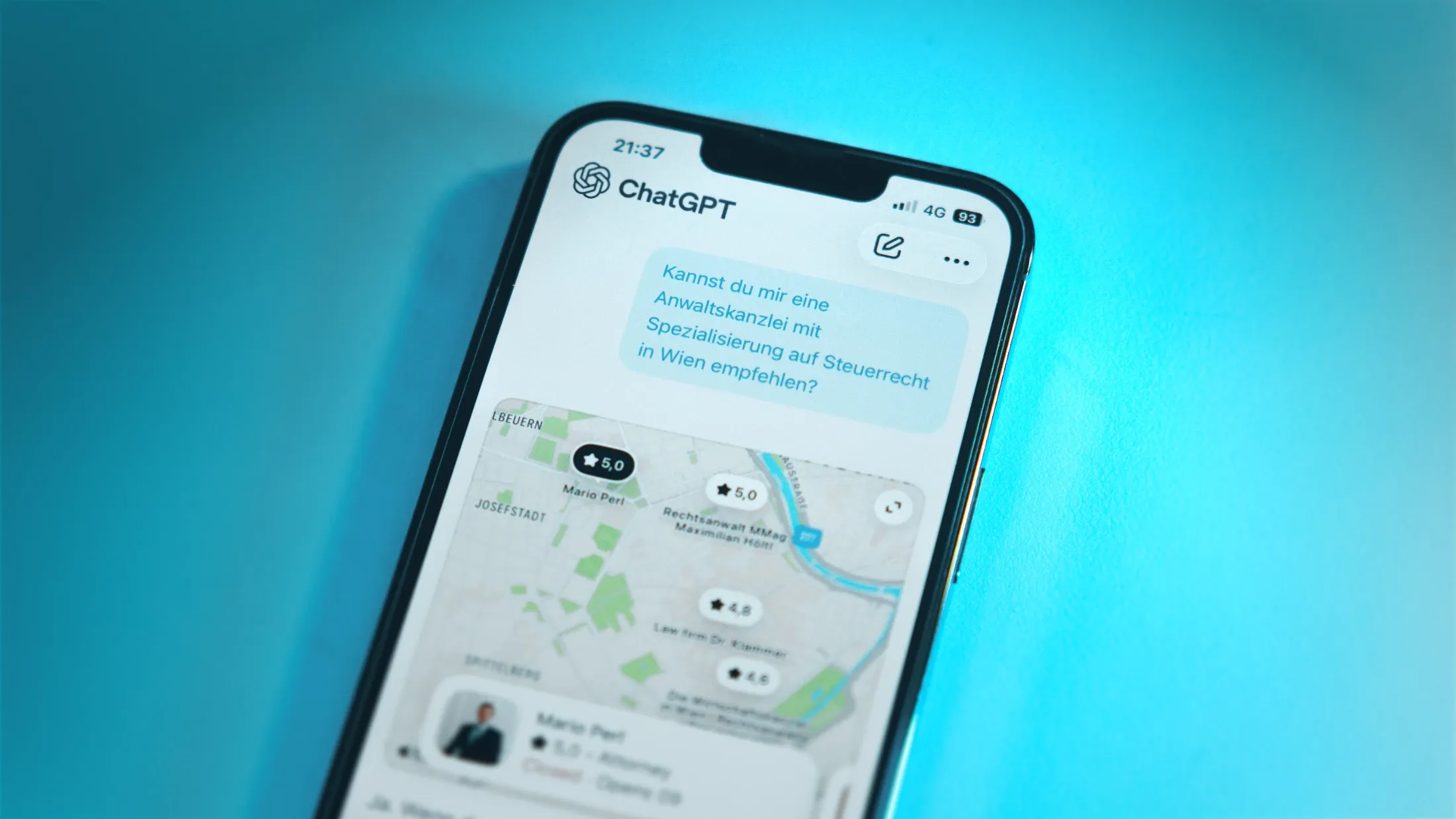
More and more people ask ChatGPT: “Can you recommend a physiotherapist in Uhlenhorst?” For exactly that question ChatGPT names Theragym today, and one in four visitors there now comes via ChatGPT.
It recommends practices that describe clearly what they offer and that other sources online confirm: reviews, directories, their own website. How that works in detail is on the AI visibility page.
Whether ChatGPT already names your practice today, the free AI check shows you.
Reviews, regular and genuine
On the map, Google looks at how many reviews you have, how regularly new ones come in and whether you reply. A few new ones a week are enough. The best moment to ask is at the end of a course of treatment, when the patient feels better: in person, with a link or a code at reception.
Buying reviews or collecting them in return for something is against Google’s rules, and it can cost you the whole profile. We never do that. Theragym stands at 5.0 from 17 reviews today, all from real patients.
What you can advertise as a physiotherapist
In Germany, physiotherapy advertising falls under the Heilmittelwerbegesetz (HWG, the law on advertising in healthcare) as soon as it’s about complaints and their treatment. The most important limit: advertising promises nothing it can’t keep. It must not suggest that success is certain or claim an effect that doesn’t exist (§ 3 HWG). You may show and quote genuine reviews from your patients, as long as they don’t mislead. Recommendations from doctors, other health professionals or celebrities, on the other hand, don’t belong in advertising (§ 11 HWG).
Before-and-after pictures aren’t banned outright for physiotherapy, but they’re tricky as soon as a picture shows a result as bigger than it is. And anyone in Germany who wants to treat self-paying patients without a doctor’s prescription needs the sector-specific Heilpraktiker licence for physiotherapy.
In Austria, the MTD Act 2024 regulates advertising (§ 39): anything that compares itself with other practices, discriminates or makes unobjective claims is banned. Showing factually what you treat, how you work and what it costs is allowed, and it’s exactly what patients want to know before the appointment. In Switzerland, the Health Professions Act (GesBG) requires advertising to be objective and neither misleading nor intrusive.
The same applies to reviews everywhere. You may ask for a review. Bought or invented ones are forbidden, and Google also bans incentives such as a discount, or asking only your happy patients. When you reply, patient confidentiality applies: never confirm that someone was treated by you.
This is an overview, not legal advice. For individual cases, your professional association (Physio Austria, PHYSIO-DEUTSCHLAND, physioswiss) or a lawyer can help. Our rule: we write factually, promise no cures and only show genuine reviews.
Online booking instead of call-backs
The phone rings while you’re treating someone, and in the evening you call back when nobody picks up any more. Every missed call is a patient who books somewhere else. With online booking on the website they book straight away, in the evening and at weekends too.
For classes and self-pay appointments this is easiest. At Theragym all class bookings run through Eversports right on the website, a few clicks to a place. For patients with a prescription, a short form is often enough, where they say what they have and when they can come. We connect whatever you already use, or help you choose.
Everything arrives there: the search, the map, the recommendation from ChatGPT. That’s why it has to be fast and show straight away what you treat, whether it’s insurance or private, where you are and how to get an appointment. If your website already does that, we work with it. If not, we rebuild it as part of the system. Just a new website, without the rest, is also an option: the physiotherapy website.
Your question isn’t here? Message me directly and I’ll answer you myself.
How do I win new patients for my physiotherapy practice?
By being found when people look for a physiotherapist, and letting them book an appointment straight away. That means: at the top of Google Maps and Google, recommended by ChatGPT, a page for every treatment and online booking. Each of these brings a little on its own; together they become a system that brings in new patients every month.
How many new patients does it bring?
At least 15 new patient enquiries a month, and we guarantee that in writing in the contract. An enquiry is any first step towards you: a call, a form, an appointment or class place booked online.
Can I decide which treatments the enquiries come for?
Yes. Self-pay, private patients, classes or particular treatments: in the first conversation we decide what new patients should come for, and we set up the system for that. For private physiotherapists every new enquiry usually counts; for practices with an insurance contract or a mix, it’s mainly the self-pay treatments.
What does physiotherapy marketing with you cost?
Found First costs €9,000, once. You pay €3,000 at the start, the remaining €6,000 only once at least 15 new patient enquiries a month are coming in. More on the Found First page and the pricing page.
What is a new patient worth to my practice?
Add up everything a patient spends with you: all the sessions in a course, plus follow-up courses, a class or training afterwards. Ten sessions at €70 already make €700, before whatever comes after. The calculator on this page shows you how many new patients it takes for Found First to pay for itself.
How quickly do the first new patients come?
Found First is planned for 90 days. You often get noticeably more enquiries after around 45 days, and it takes the full 90 days for everything to run smoothly.
How do I find new patients as a private physiotherapist?
By letting them find you on Google, on the map and in ChatGPT, and see straight away why it’s worth coming to you. That includes saying openly what a session costs and what insurance pays back: in Austria, the ÖGK refunds 80 per cent of the rate it pays a contracted therapist. Austria’s MTD Act requires that anyway, and people who know it before the appointment book more easily. More in the guide.
Does this work in a small town too?
Yes, often even faster, because fewer practices compete for the same places on the map. The guarantee applies there too: at least 15 new patient enquiries a month.
Does this work in Austria, Germany and Switzerland?
Yes. People search the same way everywhere: by place, complaint or treatment, on Google, on the map and in ChatGPT. We set the pages up for your country, for private physiotherapists in Austria, for example, or for prevention classes in Germany.
More insured patients or more self-paying ones?
Either works. We decide in the first conversation which you want more of, and the pages and search terms follow from that. Many practices want more self-paying patients and full classes, because that’s where there’s more room.
Do I need a new website for my practice?
That depends on the one you have. If it turns visitors into appointments, we work with it. If not, we rebuild it as part of Found First. Just a new website is also an option: the physiotherapy website.
Do I need Doctolib or another booking portal?
That’s up to you. A portal like Doctolib brings bookings for as long as you pay, and shows you there next to other practices. Online booking on your own website, found on Google, belongs to you. If you already use a booking tool, we connect it: at Theragym, class bookings run through Eversports.
Are Google Ads worth it for a physiotherapy practice?
For a quick start or a new class, often yes, especially ads right in Google Maps. But as soon as the budget stops, the enquiries stop too. That’s why in Found First your own channel is the foundation, and we add ads on request where they pay off. The setup is included; you pay the ad budget directly to Google.
What counts as an enquiry?
Any first step towards you: a call, a form, an email, an appointment or class place booked online. We count each one and see where it came from.
Am I allowed to advertise as a physiotherapist?
Yes, factually. In Germany the Heilmittelwerbegesetz says advertising must not promise certain success or mislead, and you may show genuine reviews from your patients. In Austria the MTD Act 2024 bans comparative and unobjective advertising; in Switzerland the Health Professions Act requires advertising that is objective and neither misleading nor intrusive. Showing what you treat, how you work and what it costs is allowed everywhere. More in the guide.
Is this GDPR-compliant?
Yes. We count enquiries and bookings, never who comes for what: health data has no place in the measurement. Forms only ask what’s needed for an appointment. We draft the privacy policy and legal notice; you should have a lawyer check them, because we’re an agency, not a law firm.
Do you have experience with physiotherapy?
Yes. For Theragym, a physiotherapy centre with its own classes in Hamburg, we built the website with online booking and around 15 pages for local search. Today more than 15 enquiries a month come in there, one in four visitors via ChatGPT.
Businesses in Austria,Germany and Switzerland grow with Studio Erlach
Let’s revolutionise how you win customers.
You get an honest assessment and a fixed price before you decide.