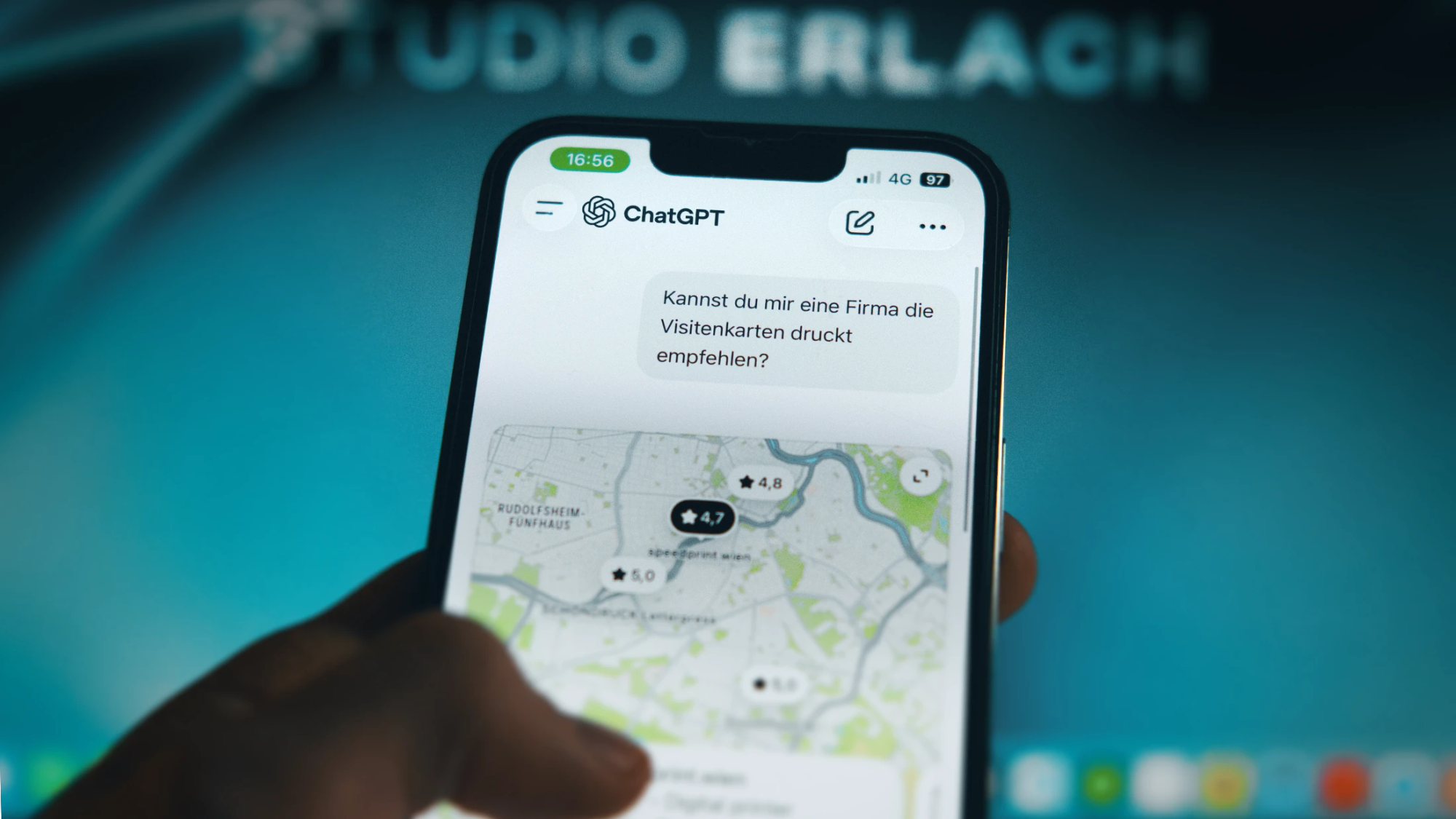
Try this in ChatGPT today: "Which tax advisor in Salzburg is good for freelancers?" You won't get ten blue links. You get an answer, with two or three names in it. And here's the question: are you one of them?
That's exactly what GEO is about. And it's about to get really big: searches for "GEO Optimierung" in Austria and Germany have grown tenfold within a single year, according to Google's Keyword Planner.
In this post we'll explain what GEO is, how it differs from SEO and where you can start today. Small spoiler: it's less new than a lot of people make it sound.
What GEO stands for
GEO stands for Generative Engine Optimization. "Generative engines" are AI systems that write you an answer instead of showing you a list of links: ChatGPT, Gemini, Perplexity, Claude and the AI answers Google now puts above its normal results.
GEO is everything that makes sure these systems know your business, understand it and name it in their answers. Some people call it AI SEO or ChatGPT SEO. Same thing.
By the way, the term comes from research: in 2023, researchers from Princeton University, among others, looked at which texts AI systems prefer to cite. More on that further down.
How it differs from SEO
Think of it like this: with SEO you're fighting for a spot in a list. With GEO you're fighting to be named in an answer. Three differences:
- How people search: On Google we type a few keywords. In ChatGPT we write whole sentences, or just say them into our phone. If you say exactly what you do, for whom and where, you match those sentences better.
- What counts in the end: With SEO, the click to your site. With GEO, the mention, often without any click at all. Someone who reads your name in an AI answer will look you up directly later.
- How you measure it: With SEO, rankings and clicks. With GEO, mentions, visitors from chatgpt.com and the enquiries that come in through it.
And now the most important part: for the most part, it's the same work. If people find you easily on Google, you're very likely to show up in ChatGPT too. GEO doesn't replace SEO, it builds on it.
How an AI decides who to name
Nobody outside OpenAI knows exactly how ChatGPT decides. From what we see with our clients, an AI needs to be able to do four things:
- Read you: Its crawlers have to be allowed onto your website. Lots of websites block them without knowing it.
- Understand you: It has to see what you do, for whom and where. A slogan like "Your reliable partner since 2004" tells it nothing.
- Trust you: It checks whether others talk about you: reviews, your Google profile, directory listings, mentions on other sites.
- Quote you: It prefers sentences that answer a question clearly. That's exactly where the 2023 research landed: texts with sources, numbers and quotes showed up in AI answers far more often.
That's basically it. The rest is legwork.
GEO in five steps
- 1. Let the AI crawlers in. Check your robots.txt (yourdomain.com/robots.txt). If GPTBot, OAI-SearchBot, ClaudeBot or PerplexityBot are listed there with "Disallow: /", you're locking out exactly the systems you want to be found in.
- 2. The one sentence. Write one sentence that says what you do, for whom and where, and put it where people see it, at the top of your homepage. Ours is: "Studio Erlach is a marketing agency from Salzburg. We make sure new customers find you first, on Google and in ChatGPT." The same sentence appears everywhere we show up.
- 3. Answers, not sales copy. Grab a sheet of paper and write down the ten questions your customers ask you most. Each one gets a clear answer on your website, with the answer right at the top, ideally with a number. That's how we built this post too, by the way: "Straight to the point" right at the top.
- 4. Your own proof. Real numbers, real photos, real cases with names. An AI would rather quote something only you can say than something that reads the same on a hundred sites.
- 5. Mentions and reviews. A well-kept Google profile, listings in directories like Herold, reviews where your customers name the service. How that works in detail is in our post on local SEO.
If you'd like us to handle this for you: here's what our GEO optimisation looks like.
How to measure GEO
- Visitors from ChatGPT: Your website stats show who comes from chatgpt.com. For our client Theragym in Hamburg, that's around a quarter of all visitors.
- Test it yourself: Once a month, put your customers' questions to ChatGPT, Gemini and Perplexity, and note down who gets named. You or the competition?
- Just ask: "How did you find us?" with every new enquiry. More and more often you'll hear: "ChatGPT recommended you." Our own latest new client came to us exactly that way.
Is GEO worth it for you?
Honestly: if your customers ask a question before they buy, which is almost every service business, then yes. And now, while most of your competitors don't even know GEO exists.
For young businesses it's actually a real opportunity: Google trusts the established players with lots of links. An AI looks more at who fits the question most precisely. Why that is, we explain in the ChatGPT SEO post linked above.
A quick word about us
Hi, we're Studio Erlach, a marketing agency from Salzburg, specialised in SEO and GEO. We make sure new customers find you first, on Google and in ChatGPT, across Austria, Germany and Switzerland.
Want to know if ChatGPT already recommends you? Request your AI check: we'll look at whether ChatGPT names you or your competitors, and what you're missing. Rather have a quick chat first? Book a call.